The Pelvis: Where Alignment, Stability, and Freedom Meet
One of the most common themes I encounter in my work is pelvic alignment. It shows up again and again — across ages, bodies, and movement histories. And while it’s often spoken about as a purely mechanical issue, the pelvis is anything but simple.
The way our pelvis functions is shaped not just by anatomy, but by lifestyle, environment, habit, and nervous system patterns that have been developing for decades.
A body not designed for chairs.
From a lifestyle perspective, it’s worth remembering that the human body was never designed to sit in chairs for hours at a time. If we look to cultures where floor-based living is still common — squatting, kneeling, sitting cross-legged — we see hips that regularly move through a wide range of positions, spines that organise themselves more naturally, and a pelvis that is continually supported through variation.
Modern furniture has quietly removed much of this from daily life. Chairs (including those in cars) tend to fix the hips at a single angle, limit pelvic movement, and encourage a tucked or overly arched position depending on the design. Over time, this affects how the pelvis sits in relation to the spine and how the surrounding muscles learn to support it. Many of us develop these lumbar compensations— not because something is “wrong,” but because the environment we relax in no longer supports natural organisation.
“Many of the ways our pelvis becomes misaligned are not faults, but intelligent responses to the environments we live and relax in.”
Add to this the way we now interact with technology. The head is frequently held forward and down, drawn towards screens. When the head moves out of alignment, the body responds — and often that response shows up at the other end of the spine. A collapsed or overstretched upper back is frequently balanced by a tailbone that presses forward, subtly bracing to keep us upright. These are not faults; they are intelligent compensations.
And crucially, these patterns tend to emerge when we are least conscious — when we are resting, working, switching off. Which is exactly when the body should be allowed to organise itself with the least effort.
It’s not about more effort.
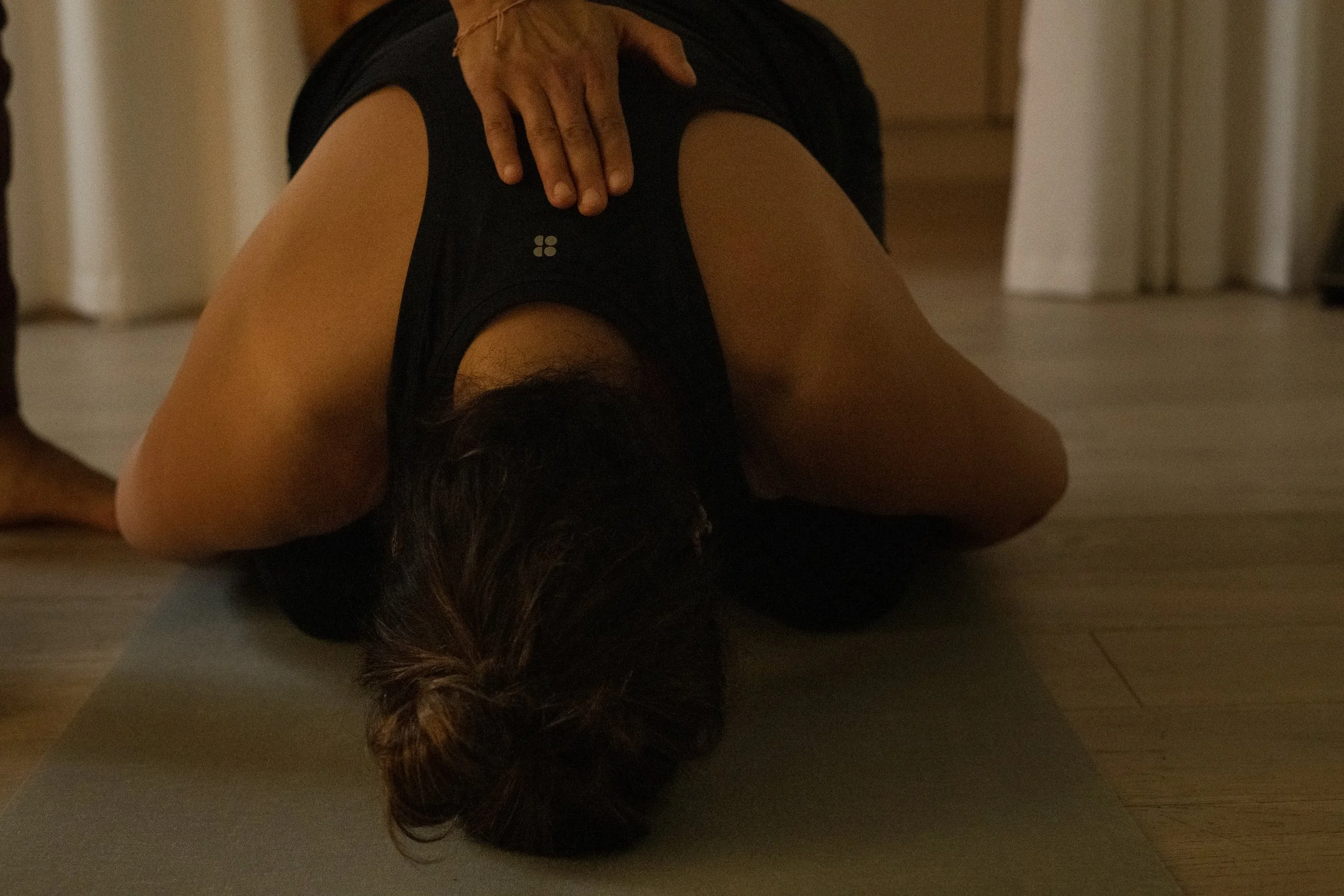
This is why the solution is not to be “on” all the time, correcting posture moment by moment. The body was designed to rest into alignment, not to hold itself there through constant vigilance.
Instead, the invitation is to gently rethink how and where we relax. Lying down rather than collapsing into a sofa. Sitting with support that allows the pelvis to soften rather than grip. Returning, occasionally, to floor-based positions — cross-legged, supported squats, varied sitting — so the hips and spine remember how to move and respond together.
Small changes here can be surprisingly powerful.
The pelvis as a foundation for balance and stability.
Functionally, the pelvis is the gateway between spine and legs. If it is unstable or chronically held, both directions are affected. The spine loses its ability to organise efficiently above, and the legs lose a reliable base below.
As we age, this matters more and more. Balance, confidence on our feet, and resilience against falls all depend on the pelvis being a place of steadiness rather than tension. This doesn’t mean rigid stability — quite the opposite. A healthy pelvis can adapt, yield, and respond, while still providing support.
The muscles around the outer pelvis, particularly the gluteal group, are often discussed only in terms of strength. But strength without elasticity quickly becomes another form of holding. Many misaligned pelvises are already working too hard, stuck in a state of low-level contraction. This can show up as lower back pain, hip flexor tightness, or a general sense of disconnection from the centre of the body.
Restoring balance here means reintroducing both give and support — allowing muscles to lengthen as much as they learn to engage.
A wider lens: the pelvis as a centre of life force.
From a yogic and energetic perspective, the pelvis holds even more. It is associated with creativity, flow, desire, sensuality, and our capacity to adapt and change. These qualities are often undervalued or deprioritised in modern culture — particularly rest, pleasure, and embodied creativity.
At the same time, we live within systems that are largely fear-based: constant warnings, precautions, insurances, and future-oriented anxieties. This has a physiological effect. The body responds to perceived threat by bracing, and the pelvis is a primary place where this holding occurs — often unconsciously.
This isn’t something we think our way out of. It’s a nervous system pattern, developed slowly and reinforced daily.
When the pelvis remains guarded, we lose more than mechanical efficiency. We lose access to a felt sense of wholeness — to the ease and fluidity that allow creativity, connection, and vitality to move through us.
“The pelvis isn’t something to fix, but something to get to know over time — through curiosity, patience, and felt experience.”
A different kind of work
This is why pelvic alignment can’t be reduced to a single exercise, cue, or corrective strategy. It requires a willingness to look in multiple directions at once — physical, emotional, energetic, and physiological.
In this recent work, I’ve been deeply struck by how transformative it is when someone truly feels where their pelvis is in space. Not intellectually, but somatically. That moment isn’t about strength or flexibility — it’s a nervous system recalibration
There is no quick fix here. Squats, deadlifts, and strong glutes alone won’t resolve it. The body has to learn that this area is safe enough to soften.
When the pelvis is well placed, it doesn’t feel tight or forced. It feels spacious. Supported. At ease And perhaps the most challenging part of this work is allowing that ease — especially in a place that has learned, over many years, to protect itself through holding.
Alignment, in this sense, is not something we impose. It’s something we return to — slowly, patiently, and with care.
Small shifts that make a real difference
This work with the pelvis continues to form a quiet foundation in my sessions — not because it’s something to “correct,” but because it’s something the body learns through repetition, safety, and support.
If you’re curious to explore this in daily life, here are three simple ways to invite a little more space and recalibration — without effort or force:
A supported squat
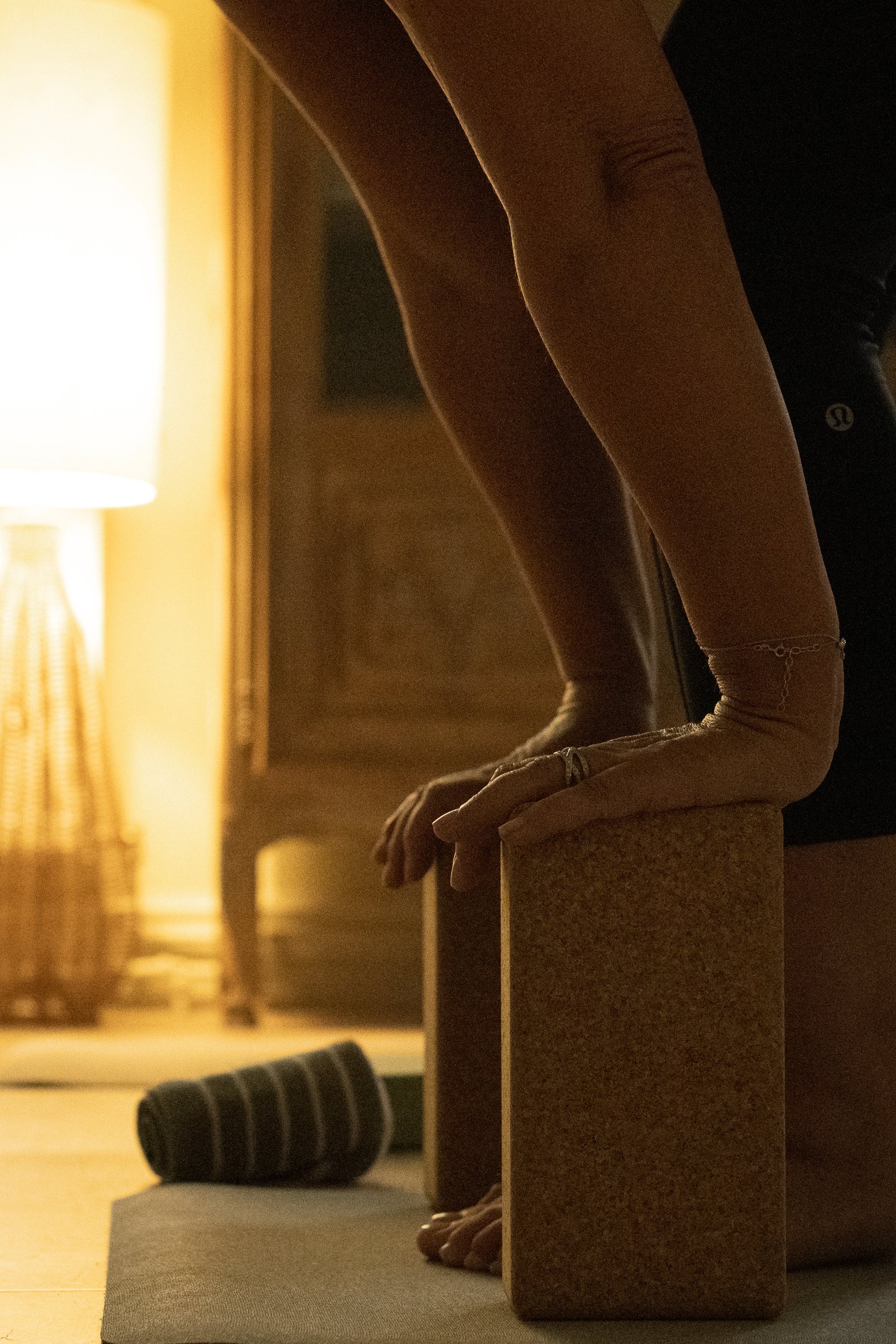
Using a cushion, block, or rolled towel under the heels or pelvis, allow yourself to rest in a squat rather than work in one. This isn’t about depth or strength, but about letting the hips and spine remember a more natural relationship. Even a short time here can gently reintroduce mobility and support around the pelvis.
Spine and pelvis reorganisation on the floor
Lying on your back with your feet placed against a wall, head supported if needed, allow the spine to settle and the pelvis to soften. There’s nothing to do here — simply notice how the body reorganises itself when gravity is working with you rather than against you. This can be especially helpful after long periods of sitting.Gentle traction and hanging
This might be as simple as letting the legs rest over the edge of a sofa or chair so the pelvis can gently “hang,” or creating a sense of length through supported traction in the studio. The intention isn’t to stretch, but to give the pelvis permission to decompress and release held tension.
These are not exercises to perfect. They are spaces to listen from.
I invite you to stay curious about this important place. The pelvis isn’t something to fix, but something to get to know over time. If a particular aspect calls to you — whether biomechanical, energetic, or simply something you’re beginning to sense more clearly —
let’s bring it into the work and explore it more deeply together.