The Architecture of Attention
On environment, attention, and what changes when the space is rightThe Spaces We Inhabit
This summer, I've found myself returning to another longstanding interest of mine: interiors.
Alongside my work at Atelier108, I work on homes—most recently an apartment in Lucca and a beach house on the California coast. Each has been distinct, but all of them have brought me back to something I was thinking about when I created Atelier108: how much a space shapes the experience of being in it.
We tend to think about interiors primarily in terms of what we see. But our response to a space is much broader than that. A hard floor returns every sound to us. A west-facing room is a different room at five o'clock. A chair placed to face the door will be sat in differently from one facing the garden.
Some rooms make us want to stay. Some encourage conversation. Some make us quieter. Others seem to pull our attention in several directions at once.
There is a beautiful idea in Japanese aesthetics called ma: the interval, or space between things. Rather than seeing empty space as something waiting to be filled, ma gives value to the space itself—the distance between two objects, the silence between sounds, the opening that allows everything around it to be perceived more clearly.
I like this because it shifts our attention away from asking what is in a space and towards noticing how a space is affecting us.
My first language has always been movement, and movement teaches this very quickly. Change the dimensions of a room and movement changes. Place another person within it and it changes again. Distance, proximity, light, sound, surface and direction all affect how we organise ourselves. A dancer learns this as part of their craft: space isn't simply where movement happens. We are continually responding to it.
Attention works in much the same way.
Our environments are constantly offering information to the senses. Before we consciously decide where to place our attention, some of that decision has already been made for us.
Space is not simply the backdrop to our experience. It is one of the things shaping it.
The Room Is Part of the Work
Which means the conditions around us are not preparation for the work. They are part of it.
Early Haṭha Yoga texts understood this practically. The Haṭha Yoga Pradīpikā gives careful attention to the place in which yoga should be practised: a clean, quiet and protected environment, free from unnecessary disturbance. The room is attended to before the practice is.
We spend a great deal of time thinking about what we should do to feel better: exercise, meditate, sleep more, breathe, slow down. The conditions in which we are asking those things to happen deserve equal consideration. Not decorating, not controlling, but consciously arranging what surrounds us in support of how we want to feel and be.
We cannot design an environment that guarantees calm, or attention, or presence. But we can design environments that support them.
This was central to why I created Atelier108.
My work had increasingly gravitated towards one-to-one practice, much of it taking place in people's homes. There is an intimacy to that experience that I have always loved: privacy, conversation, familiarity, the cup of tea, the feeling of being welcomed into someone's world.
I wanted to retain that intimacy while creating something different: the comfort of a home with the intentionality of a space devoted entirely to practice. Atelier108 wasn't created simply as somewhere to put equipment and hold sessions. Movement is the language, relationship is the methodology, and the studio is the container that holds them both.
Almost every new person who walks through the door pauses and comments on the space. Often they arrive talking—about the journey, the day they've had, what's been happening in life, what they've been noticing in their body—and somewhere in the process of arriving, things become quieter.
Nothing has happened yet, and already something has shifted.
The light, the quiet, the plants, the objects collected over time, the privacy, the separation between the two studios and the absence of interruption all contribute to the experience of being there.
For an hour or ninety minutes, the space has already been attended to. Your attention can go somewhere else.
And in this work, where it goes matters.
Building strength, changing a movement pattern, learning to organise the body differently—all of it depends on being able to feel what you are doing. That information is quiet. Where the weight actually is. Whether the breath has stopped. Which side is working harder than it should. The moment a pattern gives way and an older habit takes over instead.
It is easily drowned out. A room that asks something of us takes attention from the work: noise, interruption, the possibility of being watched, the low background sense of being somewhere temporary. The session still happens. The finer information is just harder to reach.
When the space asks for nothing, more of that attention is available for the thing itself. Effort can be felt accurately rather than guessed at. A correction lands the first time rather than the fifth. Repetition becomes learning rather than repetition.
None of which means good conditions are a requirement. People have built remarkable practices in garages, in hotel corridors, in the two metres between a sofa and a coffee table. Difficulty is not the enemy of good work, and a demanding environment can sharpen attention as easily as scatter it.
But it costs something. What a supportive space does is remove a tax that would otherwise be paid quietly, session after session, out of the same attention the work needs.
And because the conditions are the same each week, less has to be re-established each time. You arrive, and the work continues from where it was left.
That is not incidental to the practice. It is what allows the practice to be what it is.
The Space You Already Have
Most practice does not happen in a studio. It happens in a bedroom before anyone else is awake, on a kitchen floor, in the corner of a room that also does three other jobs.
This is where the idea is most useful, because it is where the conditions are least considered. We tend to treat home practice as a matter of willpower: whether we manage it, how often, for how long. Far more of it is environmental.
If the mat has to be found, unrolled and cleared for each time, some of the session is spent on that. If the space faces a pile of things waiting to be dealt with, attention goes there first. If the room is where you also work, the room will suggest working.
None of this requires a dedicated space. It requires deciding, once, where practice happens—and then making that place slightly easier to enter than it currently is. The mat left out. The corner kept clear. The phone in another room. The same spot, so that arriving takes no thought.
A regular place asks less of you than a new one. Over months, that difference is not small.
Taking the Container With Us
Summer makes all of this particularly interesting because many of us leave our usual environments behind.
We travel. We stay in hotels, rented houses or other people's homes. We spend more time with family and friends. Our routines shift and the familiar structures that ordinarily hold our days together become less predictable.
Over the years, I've realised that I instinctively create small points of familiarity wherever I go.
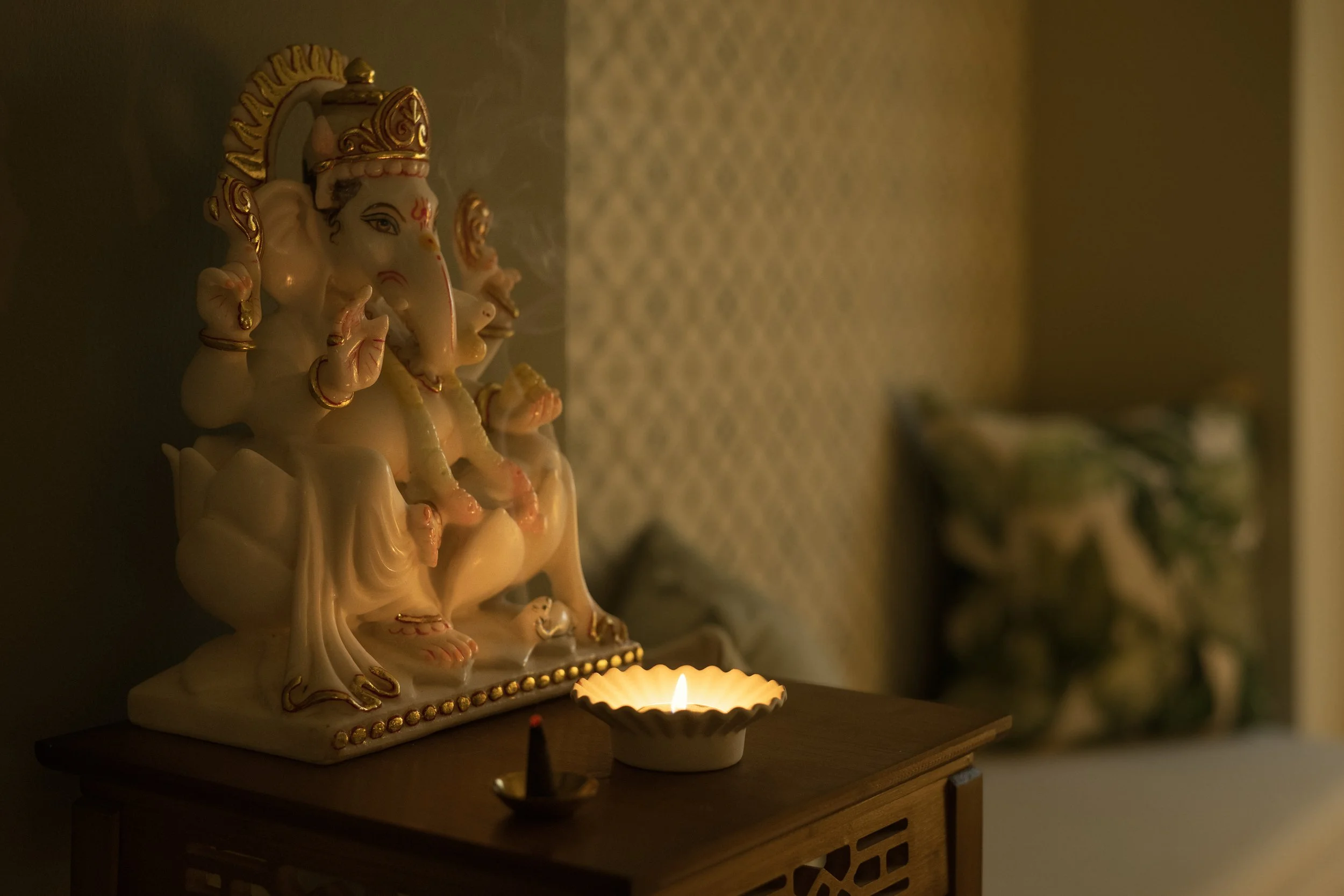
I often travel with a small candle in a scent I use at home. Lighting it in an unfamiliar room gives my senses something immediately recognisable. The surroundings may be completely new, but something within them is known.
I also establish some version of my morning fairly quickly. I get up early and find somewhere outside to walk—a park, a beach, a neighbourhood—giving myself a little space before the day gathers momentum.
These are small things, and they don't require control over very much. Light, sound, scent, what we place around ourselves, where we put our phone, whether we open the window, how we begin the morning, a familiar ritual in an unfamiliar place.
Creating space isn't about constructing the perfect environment. It is about recognising that the room is never neutral—and that arranging it, even a little, changes the quality of whatever we are trying to do inside it.
Wherever this summer takes you, I hope you find—or create—a space that allows you to arrive more fully within it.
Atelier108 will be taking its own summer pause and will reopen on Monday 7 September. Do let me know if you need any changes to your schedule, or if you are interested in starting at the studio this autumn.
I look forward to welcoming you back into the space then.